
The House Church Myth
Why the "Organic" Early Church is a Modern Invention

Picture the early church. If you have spent any time in modern evangelical circles, the image that likely comes to mind is romantic, intimate, and decidedly “organic.” We imagine a small group of believers gathered in a cozy living room, sitting in a circle. Someone strums a lyre (or a guitar), prayers are spontaneous, and everyone shares equally as the Spirit leads. There are no clergy, no liturgy, and certainly no “religious” structure.
According to some, this was the “pure” church of the Apostles: simple and relational, before it was corrupted by institutionalism, hierarchy, and the eventual rise of Constantinian Christianity.
This narrative has fueled the “Restorationist” and “Simple Church” movements for decades. It suggests that if we want to be truly biblical, we must strip away the “pagan” traditions of buildings and liturgies and get back to the living room.
The only problem with this picture is that it’s a historical myth.
While early Christians eventually met in homes due to intense persecution, the theological concept of the “House Church” as an unstructured, non-hierarchical, spontaneous gathering is a modern invention projected backward onto history. The reality is that early Christianity was liturgical, structured, and born out of the Synagogue, not some guy’s living room.
The Anatomy of the Myth
The modern house church movement relies heavily on the idea that the “institutional church” is a corruption. Proponents like Frank Viola and George Barna, in their influential book Pagan Christianity and Viola’s later work Insurgence, argue that practices such as church buildings, sermons, and professional clergy are unbiblical accretions that stifle the “organic” life of the body. Robert Banks, in Paul’s Idea of Community, similarly argues for a purely relational ecclesiology.
The scriptural defense for this view often rests on selective citations. We read in Acts 2:46 that believers were “breaking bread in their homes.” We see references to “the church in the house of Nympha” (Colossians 4:15) or Philemon.
The logic follows that if the Apostles met in homes, the home must be the ideal spiritual environment. Therefore, the move to dedicated buildings and ordered worship was a spiritual decline and a slide into “religion” rather than “relationship.”
Phase 1: The Temple and the Synagogue (AD 30 – AD 70)
However, to claim the early church rejected structure is to ignore the first forty years of Christian history. Christianity did not begin as a rejection of Jewish structure; it began as its fulfillment.
In his book The Religion of the Apostles, Fr. Stephen De Young notes that the Apostles did not view themselves as founding a new religion. They were faithful Jews who believed the Messiah had come. Consequently, they continued to worship the God of Israel in the manner He had prescribed: through the liturgical life of Israel.
When modern readers cite Acts 2:46 to support house churches, they often miss the first half of the verse: “Every day they continued to meet together in the temple courts.”
The earliest Christians maintained a dual life. They attended the Synagogue for the reading of Scripture (the Liturgy of the Word) and the Temple for the daily hours of prayer. In fact, Acts 3:1 explicitly shows Peter and John going up to the Temple “at the time of prayer.” They weren’t abandoning the institution; they were inhabiting it as its true heirs.
Paul’s missionary strategy confirms this. In Acts 13, 14, and 17, we see that upon entering a new city, Paul did not immediately rent someone’s living room and invite people over for dinner and a Bible study; he went straight to the Synagogue. The structure of the Synagogue with its readings, presidents, and prayers was the cradle of the Christian faith.
The Turning Point
If the Apostles were so committed to the Synagogue and Temple, why did they end up in homes? It wasn’t a theological preference for “cozy” gatherings. It was a matter of survival.
Two major events forced the church out of the public square:
The Jewish Revolt and the Destruction of the Second Temple (AD 70): The physical center of Jewish worship was obliterated by Rome.
The Birkat haMinim: In the late first century, a “blessing” (actually a curse) was added to the synagogue liturgy, targeting “heretics” (specifically, Nazarenes). This effectively excommunicated Christians from Jewish life.
Simultaneously, Christianity was declared religio illicita (an illegal religion) by the Roman Empire. Meeting in public meant risking death. The move to private homes was a defensive necessity driven by persecution, not an ecclesiological ideal driven by a desire for intimacy.
Phase 2: The Domus Ecclesiae (Not Your Living Room)
Even when forced into homes, the early Christians did not adopt the “organic” style of worship often promoted today. They did not sit in circles sharing feelings; they renovated their homes to mimic synagogues, and looked very much like churches today.
We have archaeological proof of this in the Dura-Europos church (c. AD 233) in Syria, the oldest identified Christian house church.
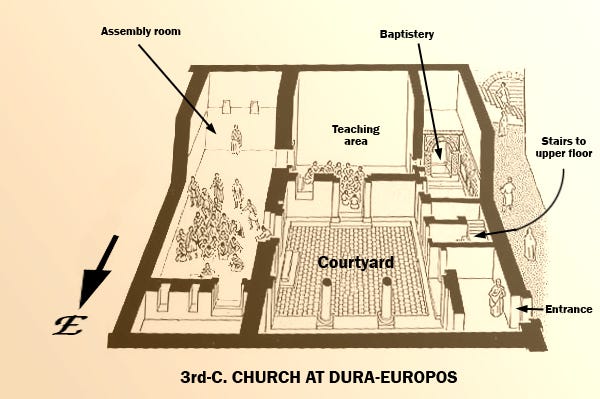
It was located in a private residence, yes. But it wasn’t a living room. The believers had knocked down walls to create a large, rectangular assembly hall (a nave). On the eastern wall, they built a raised platform for the leader (the Bishop) to stand and preside, creating a clear separation between clergy and laity. In a separate room, they installed a full baptistery framed by columns and featuring images of the Good Shepherd.
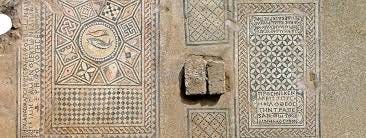
Inscriptions found in early prayer halls, such as the Megiddo church (c. AD 230), include dedications like that of a woman named Akeptous, who “offered the table to God Jesus Christ as a memorial.” They had altars (”holy tables”), not just dining tables.
Liturgical scholars have pointed out that the term “House Church” is misleading to modern ears. A better analogy might be the modern “Storefront Church.” A storefront church isn’t a UPS Store that turns into a church on Sunday. It is a space leased and renovated exclusively for worship. They were permanent renovations, making the space “sacred” (set apart), torpedoing the idea that early worship was merely a casual meeting of friends around a dinner table.
The Structure of Worship
Perhaps the deepest part of the myth is the idea of “egalitarian” worship, which supposes that in the early church, everyone shared, and there were no leaders. The historical record flatly contradicts this.
Clement of Rome, writing around AD 96 (while the Apostle John was likely still alive), wrote explicitly about order in the church. He used Old Testament Levitical analogies to describe Christian worship leaders, emphasizing that worship must be done “at the appointed times and hours” and by the appointed ministers.
Ignatius of Antioch (c. AD 107), a disciple of the Apostles, was even more blunt: “Let no one do anything properly belonging to the Church without the bishop.” For Ignatius, the validity of the Eucharist depended on the presence of the Bishop or his appointee.
So then, what did this worship actually look like? Well, it wasn’t free-form jazz or impromptu slam poetry sessions. It was a fusion of the two Jewish pillars the Apostles had grown up with:
The Liturgy of the Word (from the Synagogue): The reading of the Law and Prophets, chanting of Psalms, and a sermon or homily.
The Liturgy of the Faithful (from the Temple): The Eucharist, which the early church viewed as the new sacrificial offering prophesied in Malachi 1:11.
Even the Apostle Paul alludes to this structured tradition. In 1 Corinthians 11:23, when Paul says, “For I received from the Lord what I also passed on to you,” he’s reminding them of a liturgical formula. The words he uses (“took bread,” “gave thanks,” “broke it”) match the Eucharistic prayers (anaphora) used in the early church. Paul “received” this tradition not just from a vision, but from the liturgical assembly of the Apostles he joined.
Justin Martyr (c. AD 150) gives us a detailed outline of Sunday worship that mirrors the structure of historic Christian liturgy used today:
Readings from the Apostles and Prophets (Synagogue)
Sermon/Homily by the President (Bishop/Priest)
Intercessory Prayers
The Kiss of Peace
Presentation of Bread and Wine
The Eucharistic Prayer (The Great Amen)
Communion
This isn’t some free-flowing “kumbaya” session. It is a structured, hierarchical, liturgical service that has remained virtually unchanged for 2,000 years.
Conclusion
The “Organic House Church” narrative is compelling because it appeals to our modern democratic sensibilities. We like the idea of a faith that is purely relational, flat in structure, and spontaneous in expression.
But we must not confuse our modern preferences with the realities of ancient history. The early church moved from the Temple to the Synagogue to the Home by necessity, but they carried the reverence, structure, and order of the Temple and Synagogues with them into those homes.
To dismantle the “institutional church” in the name of returning to the “early church” is to destroy the very vessel that the early Christians built to preserve the faith. Historically, the church has always been characterized by ordained leadership, dedicated sacred space (wherever possible), and the ordered worship of God.
I appreciate the article’s attempt to challenge shallow narratives about the early church. That part is needed. The early church was not leaderless, not anti-doctrine, and not allergic to reverence. But I still believe the piece overcorrects and forces a false choice. The New Testament, and much of church scholarship, gives us a fuller picture. The claim that “organic” church language is mostly modern myth does not hold up when read against both Scripture and serious ecclesiology. The early church practiced ordered leadership, yes, but it also practiced participatory gathering, household-based discipleship, and shared ministry among the saints. The issue is not “institution versus house.” The issue is fidelity to Christ’s pattern.
Lesslie Newbigin is crucial here. In The Household of God (first published in the 1950s), he argued that different traditions each hold part of the truth about the church, and that no single structural model can claim total biblical completeness. He treated the church as missionary, eschatological, and communal, not reducible to one form. That directly challenges simplistic claims that one institutional expression alone captures New Testament intent.
Dietrich Bonhoeffer in Life Together gives another anchor. He was not advocating for anarchic spirituality. He called for concrete, disciplined, Christ-centered life in community, where believers bear one another, confess sin, submit to Scripture, and live as a real brotherhood under Jesus. That vision aligns with the shared-life texture of Acts and the participatory expectations of 1 Corinthians 14. It is ordered life, but not spectator Christianity.
When we move into modern evangelical scholarship, the same pattern appears. Robert Banks in Paul’s Idea of Community argued that Pauline communities were relational, body-based, and participatory, not built on passive consumption. Howard Snyder in The Problem of Wineskins warned that structures can either serve life or suffocate it when institutions become self-preserving. John Howard Yoder in Body Politics emphasized the visible, shared practices of the church as a living political witness, not merely a managed religious audience. These are not fringe voices. They are serious theological contributions that press us back to New Testament ecclesiology.
If we go even further back, the patristic stream also resists narrow institutional reduction. John Chrysostom’s preaching repeatedly pressed ordinary believers into active holiness, mutual care, and embodied discipleship. Cyprian and Ignatius underscore oversight and unity, yes, but neither can be honestly used to defend celebrity driven hierarchy or spiritual passivity among the people of God. Historical order is real; domination is not biblical order.
So what are we saying? We are not saying leadership does not matter. We are saying leadership exists to equip the saints, not replace them. Ephesians 4:11–12 is explicit that ministry leaders are given “for the equipping of the saints for the work of service.” If the saints are mostly watching and a few professionals are doing the ministry, we are outside the intent of the text.
We are also not saying houses are automatically biblical. A living room can host spiritual abuse. A cathedral can host faithful witness. A storefront can host healthy church life. Form alone does not sanctify anything. Christ’s lordship, scriptural authority, holy character, accountable leadership, sacrificial love, and mission to the lost are the real tests. The strongest path forward is not nostalgia and not institutional defensiveness. It is reform rooted in Scripture and confirmed by the best of church history. That means we reject chaos and control at the same time. We reject personality cults and leaderless individualism at the same time. We reject shallow activism and shallow traditionalism at the same time.
The early church was not built on branding. It was built on repentance, doctrine, prayer, table fellowship, shared suffering, and public witness. That is why Acts 2:42 and 2:46 still matters. They were devoted to apostolic teaching and also breaking bread from house to house. Temple and table. Public and personal. Leadership and participation. Order and life.
That is the synthesis this debate keeps missing.
If the goal is faithfulness, then we should stop arguing for our preferred format and start asking better questions. Are believers being discipled into obedience to Jesus? Are leaders accountable and non-dominating? Are gifts in the body actually activated? Are the weak protected? Is sin confronted biblically? Is mission central? Is Christ truly preeminent?
That is the conversation worthy of the church.
At the heart of this discussion is a deeper theological confusion shared by both primitivist and hierarchical readings of the early church. Both assume that identifying an “original” model settles the question of faithful church life. Scripture never makes that assumption. Jesus did not give His disciples a fixed institutional blueprint; He gave them authority. When He spoke of binding and loosing (Matthew 16:19; Matthew 18:18), He entrusted the church with the responsibility to discern, govern, and order its common life under the Spirit’s guidance. The early church did not merely preserve a form—it exercised judgment.
This is precisely what we see throughout the New Testament. The Jerusalem Council in Acts 15 does not appeal to an earlier pattern and declare the matter settled; it discerns, debates, listens to testimony, weighs Scripture, and then binds a decision suited to new circumstances. Paul does the same in his letters, addressing worship, leadership, discipline, and community life differently in Corinth, Galatia, and Thessalonica—not because the gospel changed, but because pastoral realities differed. Unity was grounded in Christ, not in uniformity of practice.
Seen this way, primitivism is not a return to biblical faithfulness but a denial of biblical authority. It freezes the church at its earliest moment and strips it of the very authority Christ gave it to live wisely in history. At the same time, appeals to later uniform liturgical or hierarchical systems as if they were divinely fixed from the beginning make the opposite error—confusing faithful development with timeless mandate. The early church neither idolized its first forms nor absolutized its later ones. Neither forensic archaeology nor forensic document retrieval will ever settle this issue.
The historical record, read carefully, supports this biblical vision. Early Christians valued order, leadership, and reverent worship, yet they adapted these in response to persecution, culture, mission, and growth. Homes became gathering places not because intimacy was an ecclesial ideal, but because circumstances demanded it. Structures emerged not because uniformity was required, but because love, discipline, and truth needed to be protected. What remained constant was not form, but fidelity to Christ.
Faithfulness, then, is not found in dismantling structure in the name of the “early church,” nor in preserving structure as if it were itself the faith. It is found in the church’s ongoing willingness to bind and loose responsibly—to order its worship, leadership, and life together in obedience to Christ and attentiveness to the Spirit. That is not a betrayal of the early church. It is precisely how the early church lived.